
Summary
Between geopolitical tensions and the drive towards electrification, ports’ conventional grid connections are struggling to keep up with their power demand. More and more, the need for energy resilience becomes a key consideration for terminal operators. Port microgrids are the industry response to these challenges, allowing operators to generate, distribute, and manage power locally without the limitations of grid congestion or disturbances.
Introduction
The global drive for the electrification of port operations has brought drastic changes to the field. Energy has transformed from a background utility into a strategic resource, and it shows. Looking at modern ports, they might more closely resemble an energy plant than the traditional container yards we’re used to. And as geopolitical tensions rise and power systems face increasing strain, ports are being forced to rethink how they secure and control their energy supply.
A single grid disturbance can halt cargo movement, disrupt national supply chains, and create vulnerabilities in the systems that keep countries running. This is why microgrids are emerging as the backbone of modern ports: Resilient, controllable energy systems that ensure continued operations under any circumstance.
Microgrids: What are they?
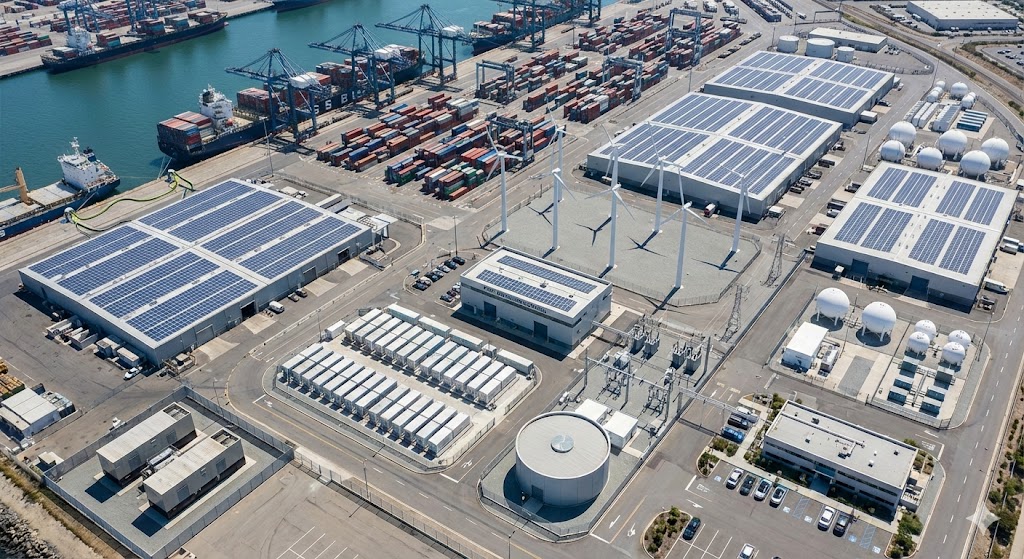
Microgrids are decentralized, autonomous energy systems that integrate distributed energy sources (DERs)—renewables, batteries, flywheels, shore power, hydrogen, EV charging, backup generators—and manage them on-site. Essentially, these systems generate, distribute, and manage power locally. A port microgrid is a port which provides its own power on-site, freeing them from traditional grid limitations. Microgrids can be connected to the grid, but can also be ‘islanded’ and work fully independent from the main grid, which is ideal during power outages or disturbances, making a more controlled, resilient system.
In port environments, microgrids typically appear in three forms:
- Greenfield microgrids: Built where no grid exists, such as in developing regions or newly expanded terminals
- Hybrid microgrids: These are grid connected but use renewables and storage to improve stability and independence
- Fully islandable microgrids: These operate fully independently when the main grid is congested, unstable, or compromised
All share the same goal: Ensuring that port operations remain secure, uninterrupted, and energy-independent.

What’s in it for ports?
Ports make for perfect candidates for microgrids for five reasons:
Need for resilience
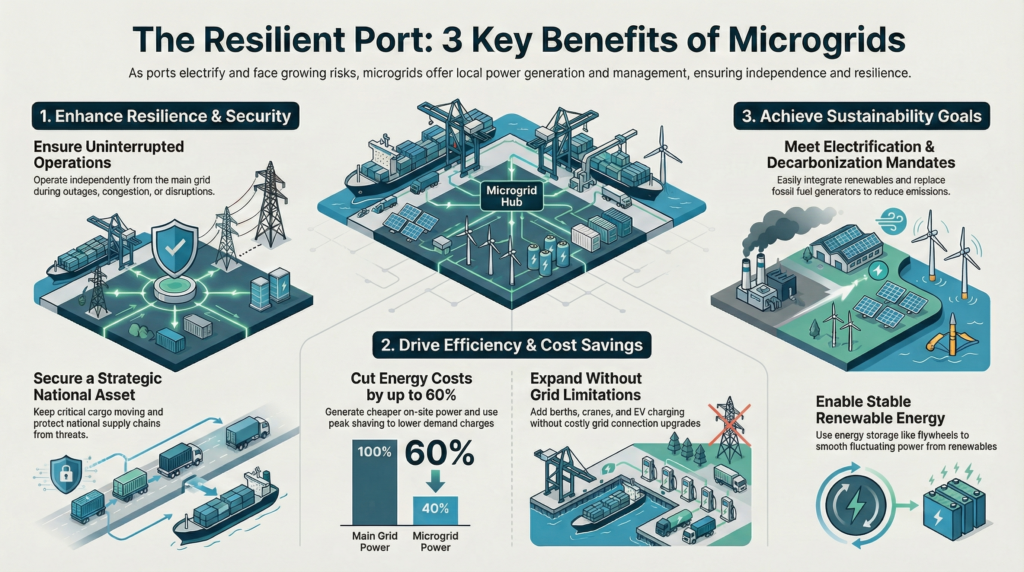
Ports are not just economic engines; they are strategic assets. We’ve seen global tensions greatly affect trade—as the nodes that connect our world, ports make for ideal targets for sabotage, and as such must remain operational despite external conditions. Beyond that, grid congestion is an ever-increasing concern, and a reliable power supply is key for ports.
Microgrids offer a controlled, local energy environment that keeps essential functions running even if the main grid is unstable, congested, or deliberately disrupted. This resilience is increasingly vital as ports face greater electrification needs, growing cyber-physical threats, and dual-use requirements for both civilian and strategic operations.
Thus, a microgrid prevents downtime when the main grid fails, allowing ports to keep running no matter what.
Pressures to electrify & decarbonize
Various economic and legislative factors are pushing ports to electrify, with three key requirements:
- Zero-emission shore power
- Reduced local pollution
- Cleaner inland logistics
Adopting a microgrid format helps ports replace generators and integrate renewables, leading to a reduction in emissions.
Energy cost savings
A study on a Port of San Diego terminal estimated a 60% reduction in energy costs by transitioning to a microgrid. These savings reportedly stem from the microgrid’s generation of electrical energy and peak shaving, a substantial finding that could change the game.
Grid limitations
With increasing demands in global trade, ports need to keep growing. This means more berths, more ships, more cranes, and more power—all things that are bottlenecked by the port’s grid connection. Add the need to switch to electrical equipment, and ports have a hard time growing, especially when the grid does not allow for upgrades. A microgrid solves this by combining renewable energy generation with on-site storage, completely eliminating the need for a bigger grid connection and allowing ports to continue expanding their operations to keep up with demands.
Peak management
Academic literature has highlighted the need for increased peak awareness and management in port microgrids (Fan et al., 2023). Here, QuinteQ sees a strong case for our peak shaving powerhouse, the flywheel. But what can flywheels really do for port microgrids?
Managing port power requirements
Take a generator that is powering a quay crane. The generator is most efficient at around 90% power output (say, 400kW), but a crane has highly fluctuating power requirements. It can go from 10kW at rest to 500kW when lifting a container in less than a minute, making the generator have to switch from a 5% output range to close to 95%. This switch leads to excess fuel being used and requires the generator to be oversized to match the peak power load, even if it only reaches that peak a handful of times per day. A flywheel works as a shock absorber, allowing the generator to work at consistent outputs as the crane functions, saving on fuel costs.
Peak shaving ships and cranes
We’d be remiss to not mention the bread-and-butter of flywheels: Peakshaving. Our energy storage solution is built to peak shave the power demands of ports by up to 65%. Various port operations cause high power peaks, such as:
- Crane lifts
- Shore power for vessels
- EV machinery
- Cold ironing for cruise/cargo ships
These power peaks are difficult and expensive to manage, often exceeding grid capacity. By isolating the port from the grid and having it generate its own energy, this issue is completely bypassed, making a more reliable (and cheaper) port.
This has the added benefit of decreasing ports’ reliance on fossil fuels, which often have to be sourced internationally and are thus subject to geopolitical conflicts. By decreasing power demand, less fossil fuels are needed to run generators, for example. And while microgrids already offer energy savings, flywheels can reduce costs even more by capturing and reusing brake energy, saving fuel, and eliminating unnecessary generator start-stops.
Making space for renewables
Flywheels can also allow the integration of renewable energy sources. These tend to have high fluctuations in energy generation, increasing costs and making their implementation more unappealing. Our flywheels smoothen these fluctuations, providing a more stable and reliable source of energy. This further decreases the need for fossil fuels in ports, making them less dependent on international, precarious sources.
Reliable, resilient, and quality power
Flywheels are built to last, with a mechanical design that has a long lifespan with low maintenance requirements. The design is completely recyclable, uses no toxic materials or rare earth minerals, and is manufactured in the Netherlands. This makes it a safe and sustainable option that is independent of global supply chain challenges.
Conclusion
Beyond the energy transition, ports have been re-evaluating their role as energy consumers to energy producers. Their strategic importance and their role in global trade has put them in the unique position of having to ensure that their operations can continue running in the most extreme circumstances. A leading solution to this need for energy resilience is the microgrid system, which allows ports to manage their own energy and prevent shutdowns when the rest of the region suffers from power outages.
By integrating renewable energy sources, advanced storage technologies, and applying intelligent power management, port microgrids not only enhance resilience but also long-term sustainability goals and cost-efficient operations. As ports continue to modernize and expand, microgrids stand out as a future-proof investment, strengthening energy security today while enabling cleaner and more adaptable port infrastructures for tomorrow.
References
Fan, S., Ai, Q., Xu, G., Xing, H., & Gao, Y. (2023). Cooperative coordination between port microgrid and berthed ships with emission limitation and peak awareness. Energy Reports, 9, pp. 1657–1670. https://doi.org/10.1016/j.egyr.2023.04.225
Molavi, A., Shi, J., Wu, Y., & Lim, G. J. (2020). Enabling smart ports through the integration of microgrids: A two-stage stochastic programming approach. Applied Energy, 258. https://doi.org/10.1016/j.apenergy.2019.114022